
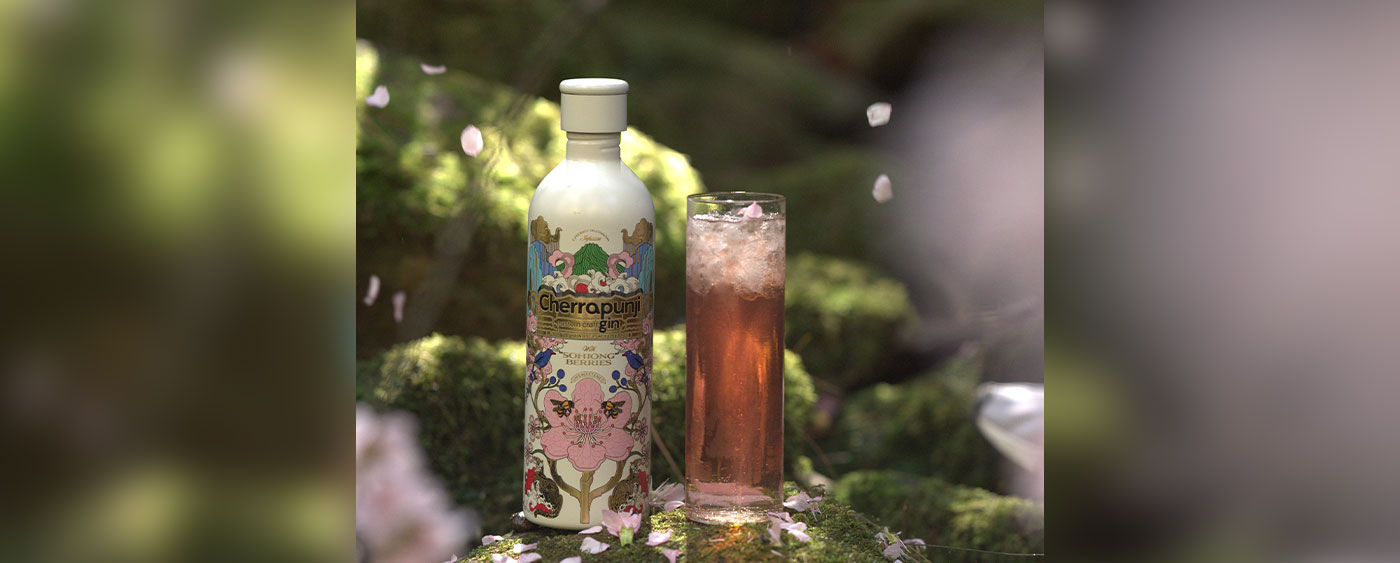
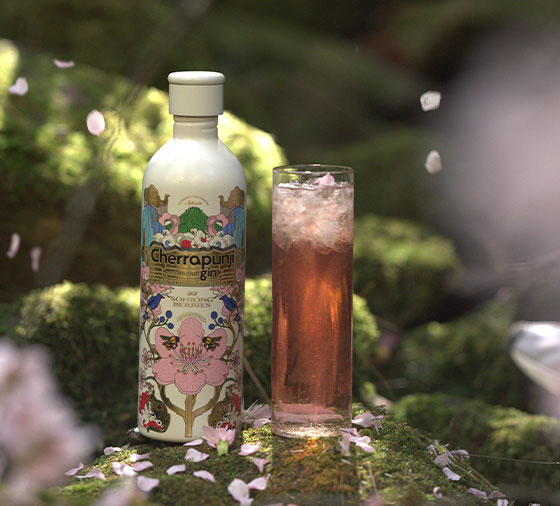
A Misty-cal Gin from the World’s Rainiest Place
- Spirits
- |
- 30 January 26
- Priya Kumari Rana
The only gin in the world made from fresh rainwater, 12 farmer-sourced botanicals, and with its newest pink expression made from the rare Sohiong berry that only ripens once a year for six weeks, Cherrapunji Eastern Craft Gin is India’s most awarded gin. We travel to Shillong, Meghalaya to taste the new Mountain Berry Gin with Cherry Blossom, do a distillery tour, and feast on delicious Khasi cuisine.
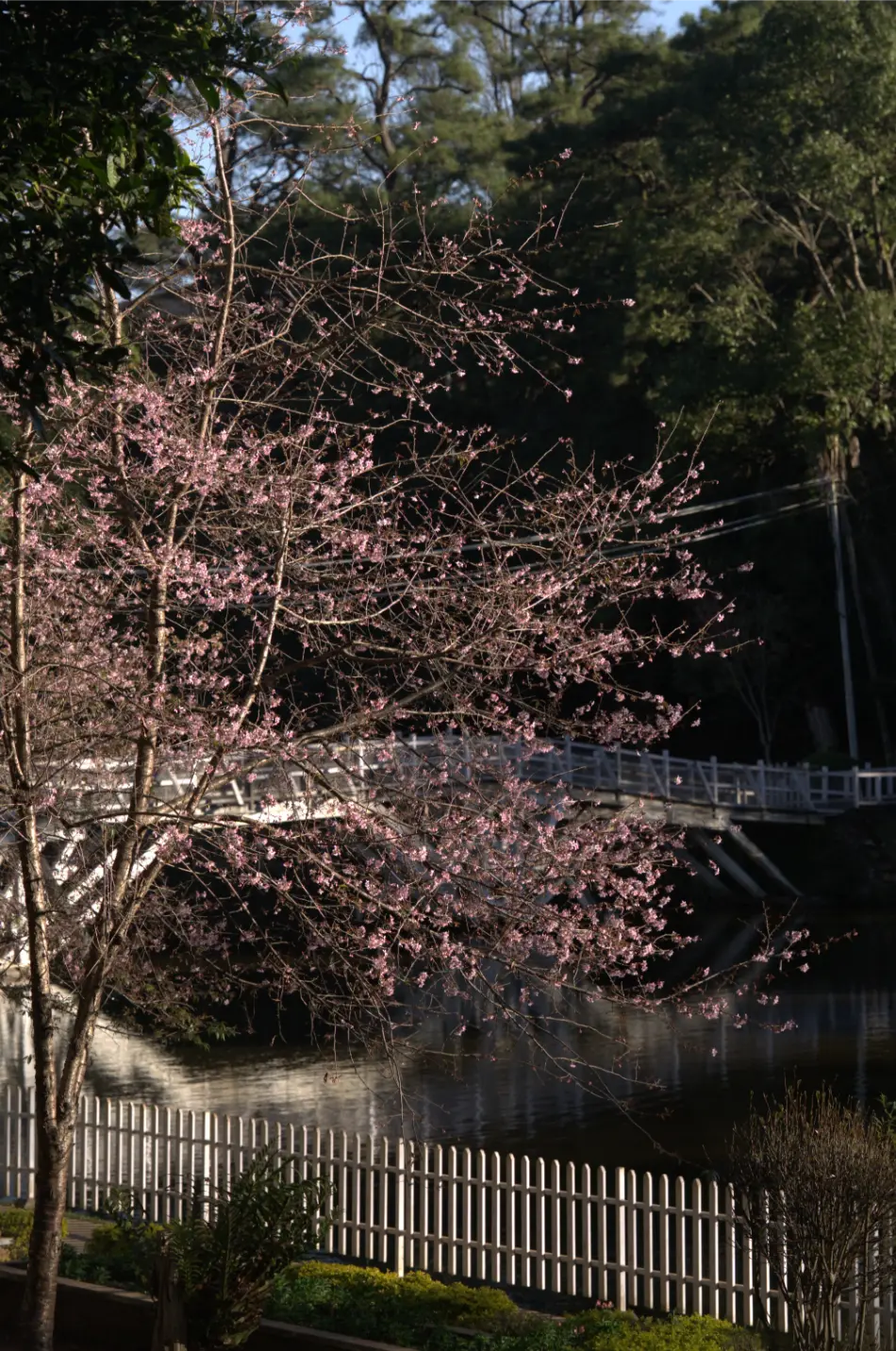 A reservoir surrounded by cherry blossoms in Shillong
As we wind our way from Guwahati to Shillong through a scenic road lined with pine trees, reservoirs, local vendors selling pineapples and jams, and villages with lots of new construction, I breathe in the crisp, slightly humid air that is only found in Meghalaya. The sun is smiling from a clear, bright blue sky, the kind my weary city soul has not spotted in a while. I’m here at the invitation of the makers of the award-winning Cherrapunji Eastern Craft Gin, the only gin made with rainwater, for the launch of their second and latest expression, the only gin made with the local Sohiong berry, the Mountain Berry Gin with Cherry Blossom.
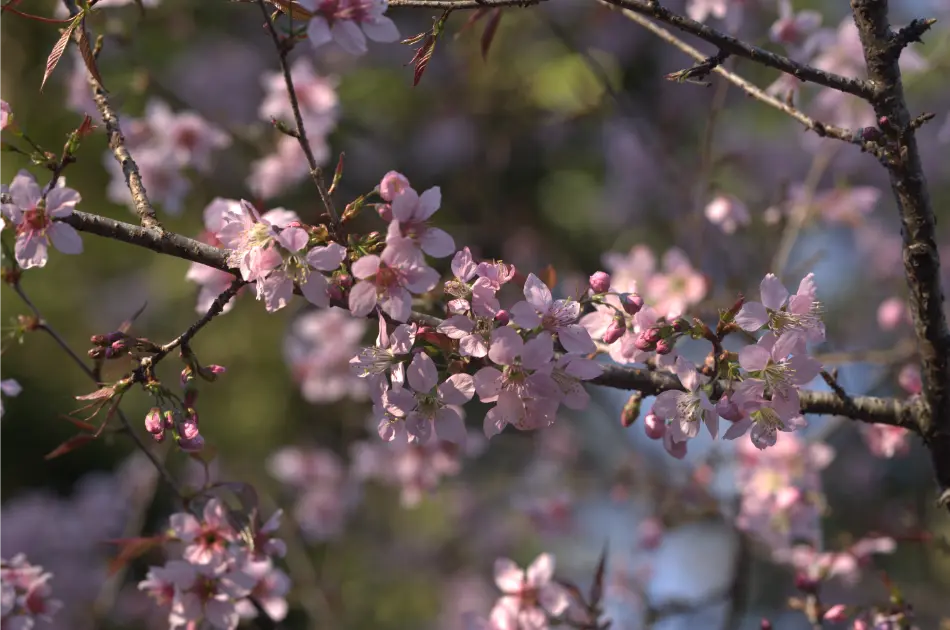 Cherry blossoms of Meghalaya
Think local, act global
The fact that the water that goes into it is rainwater is unsurprising, as we are literally, in and around misty Cherrapunji – the place with the world’s heaviest rainfall. “Technically, it’s Mawsynram that has the highest rainfall (467 inches a year!); they are next to each other,” says Mayukh Hazarika, founder and CEO of Raincheck Earth, the brains behind Cherrapunji Eastern Craft Gin, over drinks and dinner at Rynsan, Shillong, voted last year amongst India’s top 50 restaurants. “There are two hills, actually. And my idea was to make a gin which is truly from this place – as gin is one of the only spirits that can take the character of its birthplace.”
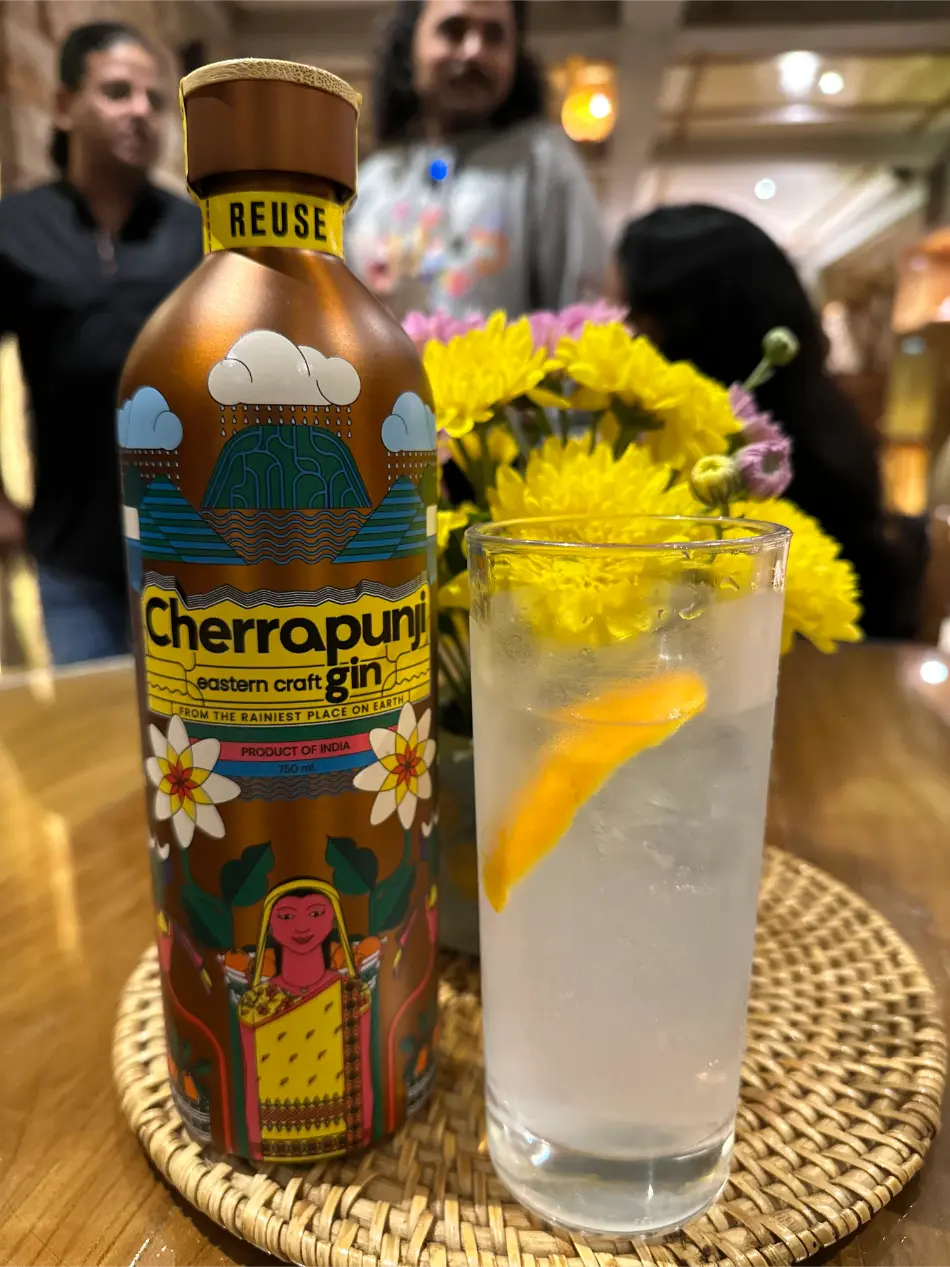 The original Cherrapunji Eastern Craft Gin in a 'Gin Sonic' cocktail
Among the many botanicals the original expression of Cherrapunji Craft Gin is infused in (the botanicals are always dried, before infusion), such as juniper (a must, for the spirit to be called a gin), there is the local Khasi mandarin, local pepper, liquorice, angelica root, smoked cardamom from Sikkim, and smoked tea from Manipur.
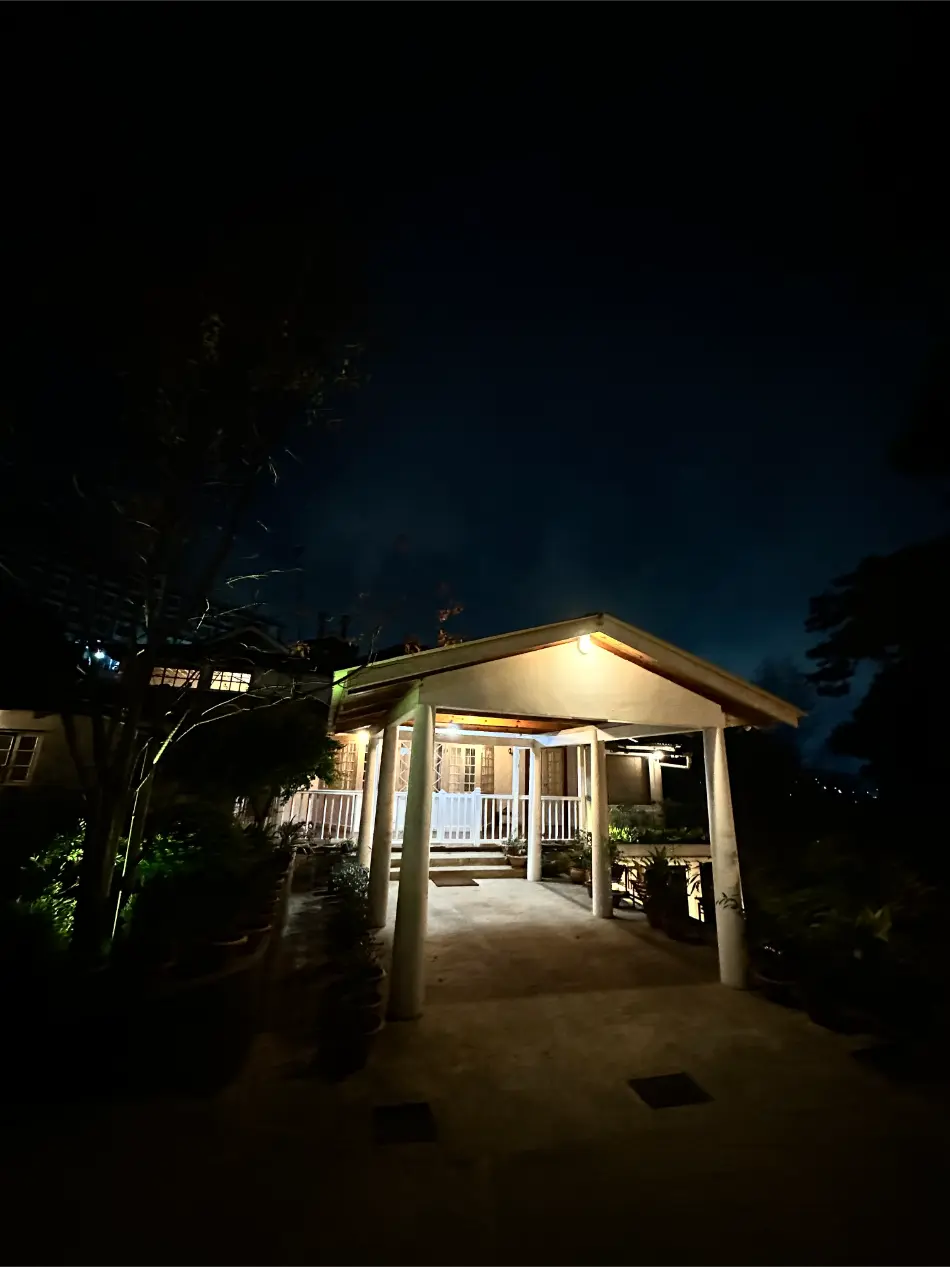 Rynsan Shillong, at night
“I’ve taken inspiration from our food here, especially the smoked meats, so you will get that smoky element in the gin,” says Mayukh. “And this comes from the tea we use – which is smoked with pine needles.” This starts to make sense as one realizes the topography of Meghalaya and the fact that so many indigenous fruits and vegetables grow here.
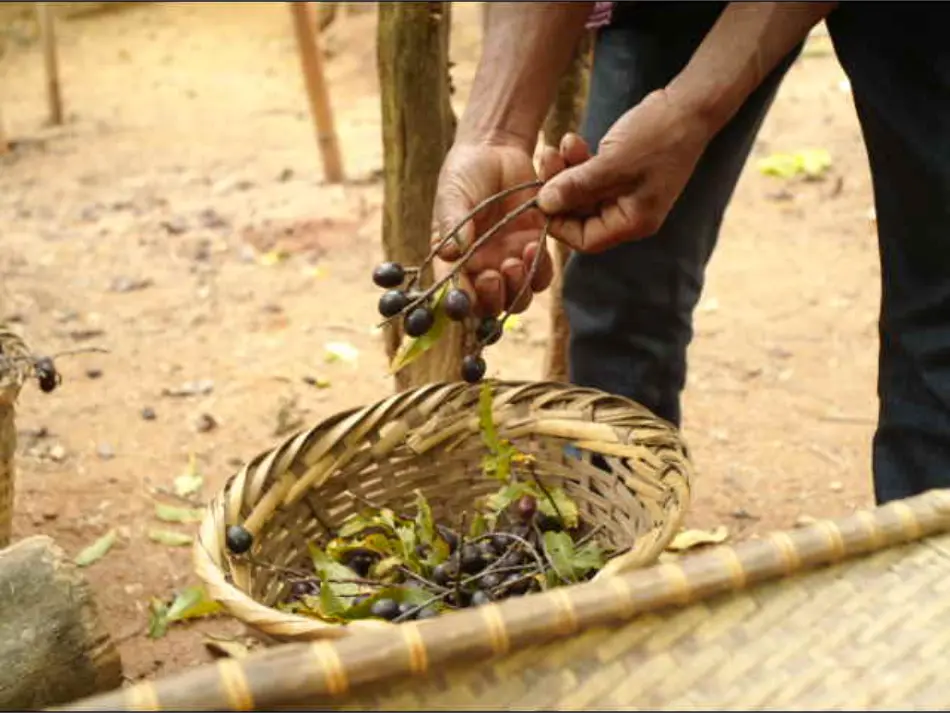 Farmers picking the Sohiong berries
What’s of interest to us, as far as the new expression is concerned, is the Sohiong berries that grow in the wild. “These are not cultivated, and there’s no genetic modification going on here, thank God,” says Mayukh, “The Sohiong berry only appears for six weeks, and our newest expression, the Mountain Berry Gin with Cherry Blossom, is all about that.”
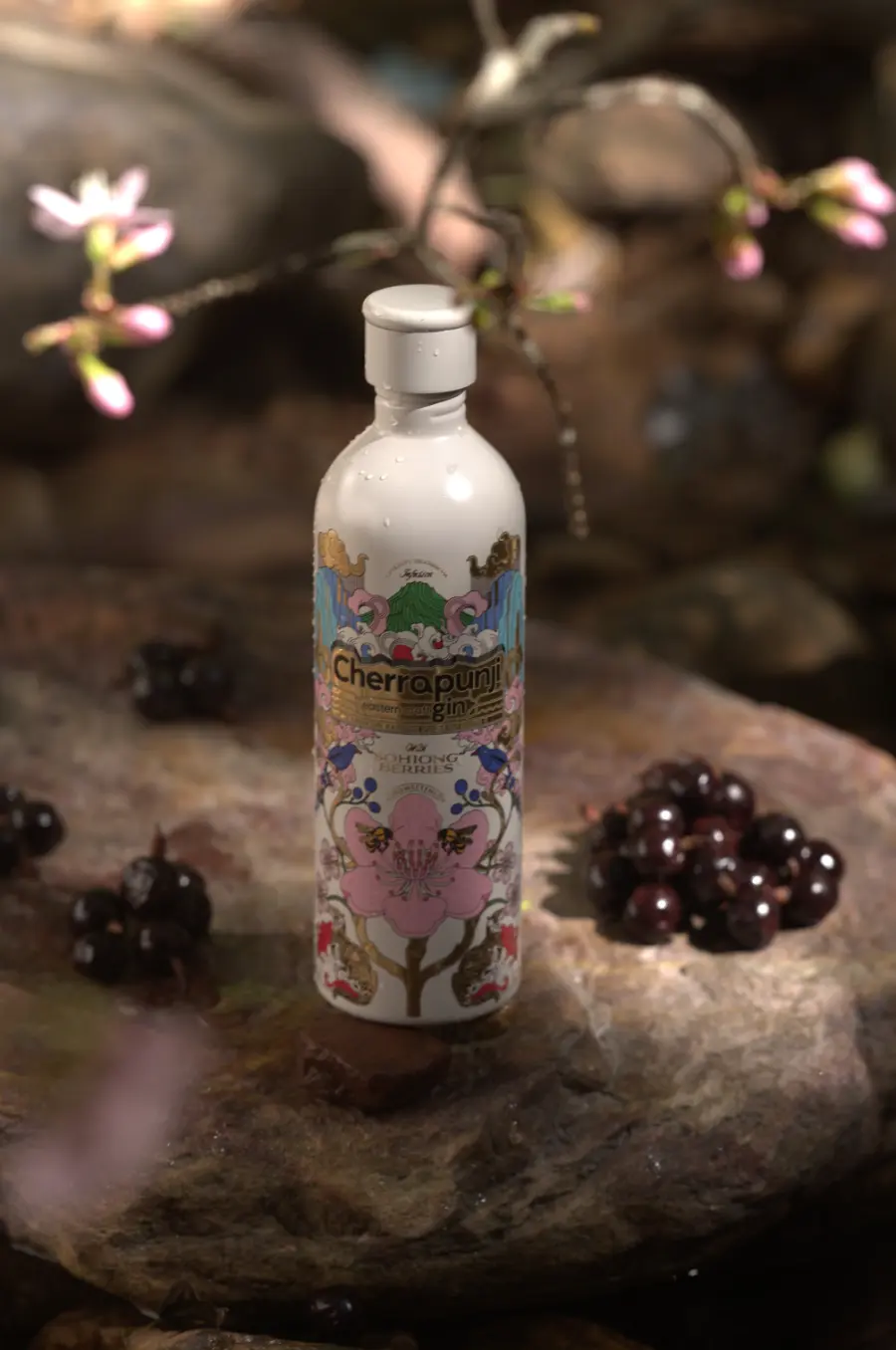 Mountain Berry Gin with Cherry Blossom surrounded by the Sohiong berries
The passion behind India’s most awarded gin
Shillong-born, IIM Indore-educated Mayukh worked as a marketing professional for some of the world’s largest corporations, but has always been a passionate home brewer and distiller. “I never thought I would work with anything related to alcohol,” he says, “But as Covid happened, there was so much time at hand – it was December 2021 – and I told myself, ‘I’m done working for others; I’m going to do something myself.’” So he wrote down three business ideas, setting the 5th of January as his deadline for action. He finally picked this idea of making gin – of doing it from his birthplace and taking it to the world. “Call it reverse tourism, if you will,” he says.
 Founder Mayukh Hazarika and his trusted team at the distillery
Mayukh got his trusted team together (whom we meet the next day at the distillery), two of them, Richard and Himanshu, childhood friends/friends for decades, and one of them, Reshidev RK, a designer based in, Portland, Oregon, was assigned the fun task of designing the special copper-painted reusable stainless steel bottle of Cherrapunji Eastern Craft Gin, with colourful graphics depicting the Cherrapunji hills, a farmer woman picking Khasi mandarins, the mandarin itself, and the natural fauna and flora of Meghalaya.
Cherrapunji Craft Gin is a world-class product, and also India’s most globally awarded gin. Winner of 15 global awards, positioned in international markets from Bahrain to Belgium, and Africa. It’s tasting notes are citrusy, with that spicy kick from the pepper, and of course, smoky. Drunk neat, with a splash of water, or in a Gin Sonic, a word play that combines soda with tonic water in equal halves, it pairs wonderfully with the dishes at Rynsan.
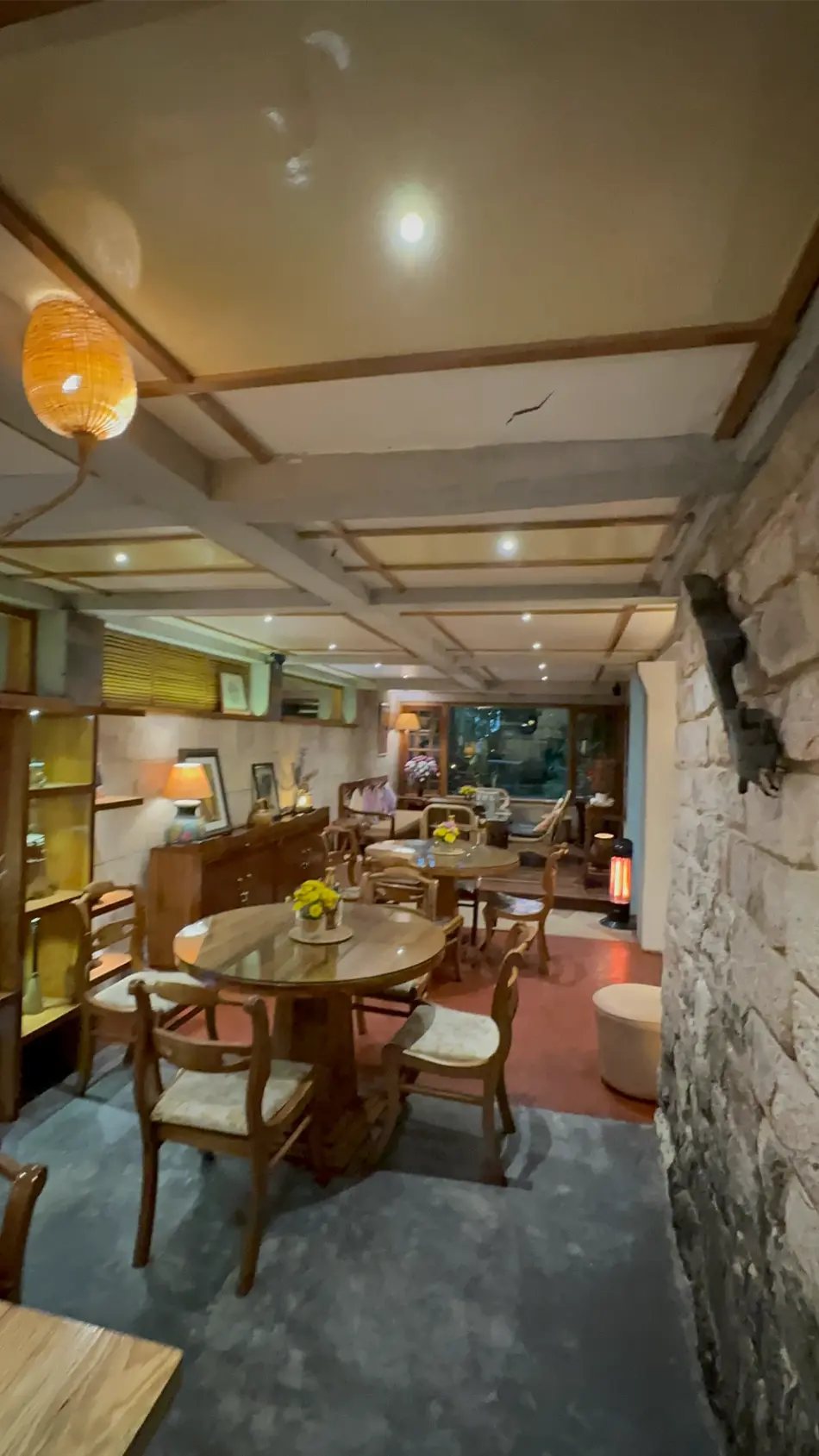 The warm wooden interiors of Rynsam
A cozy environment to enjoy Khasi fare
A wooden house, in the true Khasi tradition, set on a terraced garden Rynsan is like a family’s living room, which invites you to taste the local flavours of the region. As one enters, a small foyer displays art, locally made black pottery artefacts, stoles made out of Ahimsa silk, and musical instruments, since the owner, Hammarsing Kharhmar is a musician. His charming wife Riyaki Jana says that the house is especially cozy in the winter as it’s made using large blocks of Sohra stone (for insulation), and wood.
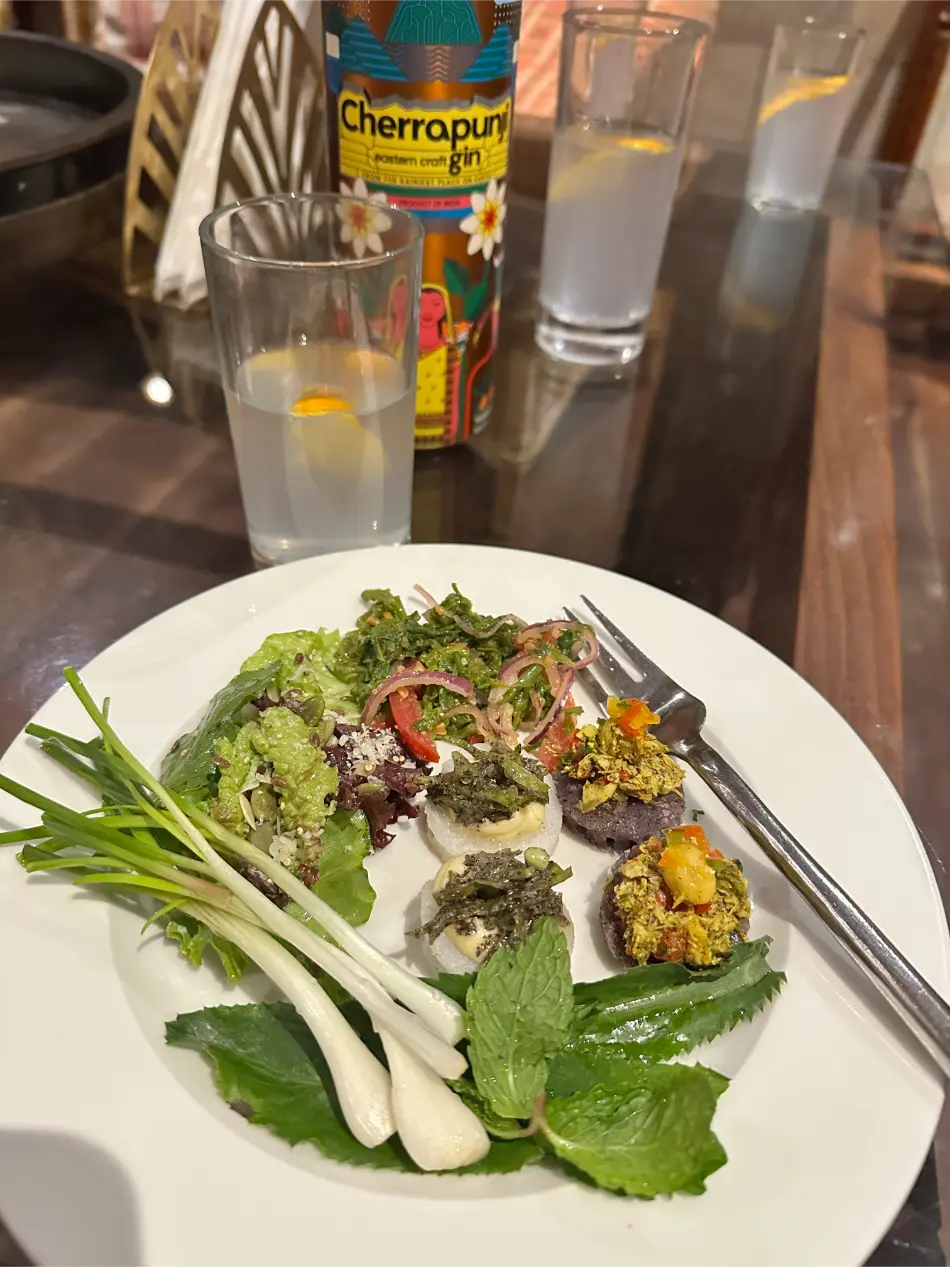 Khasi delicacies at Rynsan
For starters, we are served Putharo (steamed rice cake) sliders with smoked pork, Salad with spring onions, Crispy (bamboo) shoots, and then we have Jastem (yellow rice with turmeric), Kholar Bean Potato Datshi (a stew); Jhur Nei Iong (green curry), a Wild Fern salad, and spicy noodles.
All the ingredients are locally sourced, with many herbs and seasonal greens found in Rynsan’s kitchen garden. For example, the lemons they use actually grow right outside the window.
 Umiam Reservoir near Shillong
A day at the distillery
The next day, after an hour’s drive from Shillong along a cherry blossom-lined road, we find ourselves at the Cherrapunji Gin distillery, the front of which bears the motto ‘Without Rain there is no Life’, a nod to the gin’s use of rainwater. At the entrance, a long, fern-decorated table is set for lunch under a piercing azure sky, surrounded by eucalyptus trees.
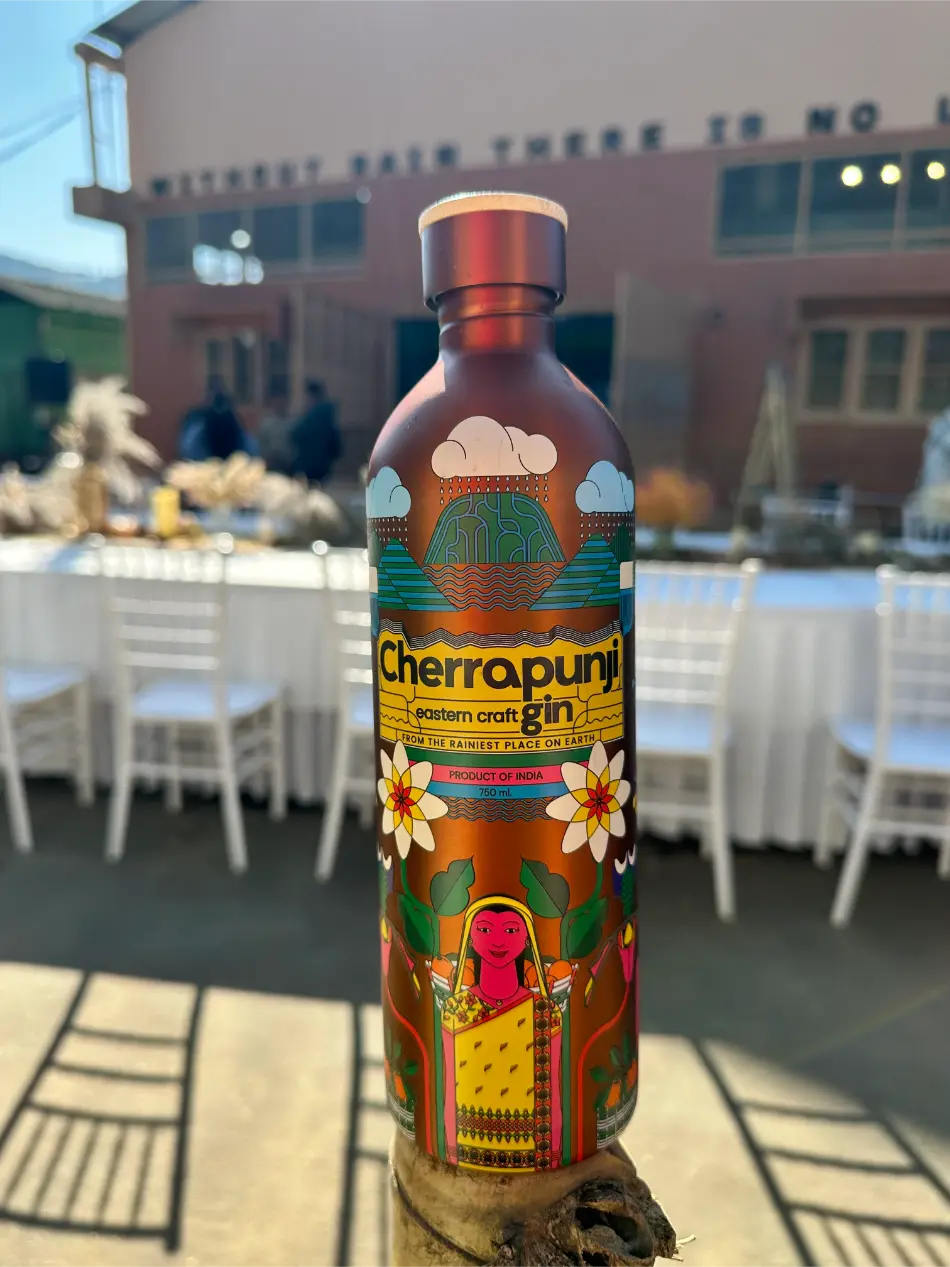 The original Cherrapunji Eastern Craft Gin, against the distillery as backdrop
Mayukh ushers us inside, to the distillation stills, where the magic happens. On the walls, Cherrapunji Eastern Craft Gin’s awards are displayed, with plaques from: SIP Awards California (Double Gold, 2025), London Spirits Competition (Silver, 2024), The Gin Guide – Bottle of the Year (2024), The Gin Guide – Design and Branding (2024), Global Drinks Intel, World Gin Awards (Silver, 2024), The Spirits Business – Global Gin Masters (Gold, 2024), The Spirits Business – Global Travel Retail Masters (2024, as the highest selling gin in Delhi Duty Free).
“This is the house of Mr Fulgens,” says Mayukh, pointing to a mural inside depicting the furtive and impossibly cute little red panda who lives – albeit elusively – in this mountainous region south of the Himalayas. “His scientific name is Ailurus fulgens, and he’s our mascot.” Mayukh has affectionately named the Dutch steel machine that makes the gin Mr Fulgens, after the small red panda.
“We are the only company that we know of that processes its own botanicals,” says Mayukh. “We take the peel of the Khasi mandarin, but don’t need the fruit. So we give away the pulp, free to farmers and jam factories. No one else takes this kind of pain for their botanicals.” The same goes for the GI-tagged Assamese lemon that goes into the gin.
Mr Fulgens – the pot still – receives the botanicals (in the right proportions, all meticulously calibrated by the master distiller Aanchal Sharma) and the rice/grain spirit to make the gin. “It takes 17-18 hours to make 600 bottles of gin,” says Mayukh. “Then the spirit sits in the tank for 3-6 months to get a more rounded flavour. We are the only ones who keep the gin for so long, because gin isn’t something you age. I know of only one other company – Monkey 47 – that ages its gin.”
Mayukh points to two smaller machines – used for experimental brands (such as the small Christmas batch we make later in the day), when the main still is being cleaned. But he has big plans, a bigger distillery is coming up close by, with a 5,000-litre still.
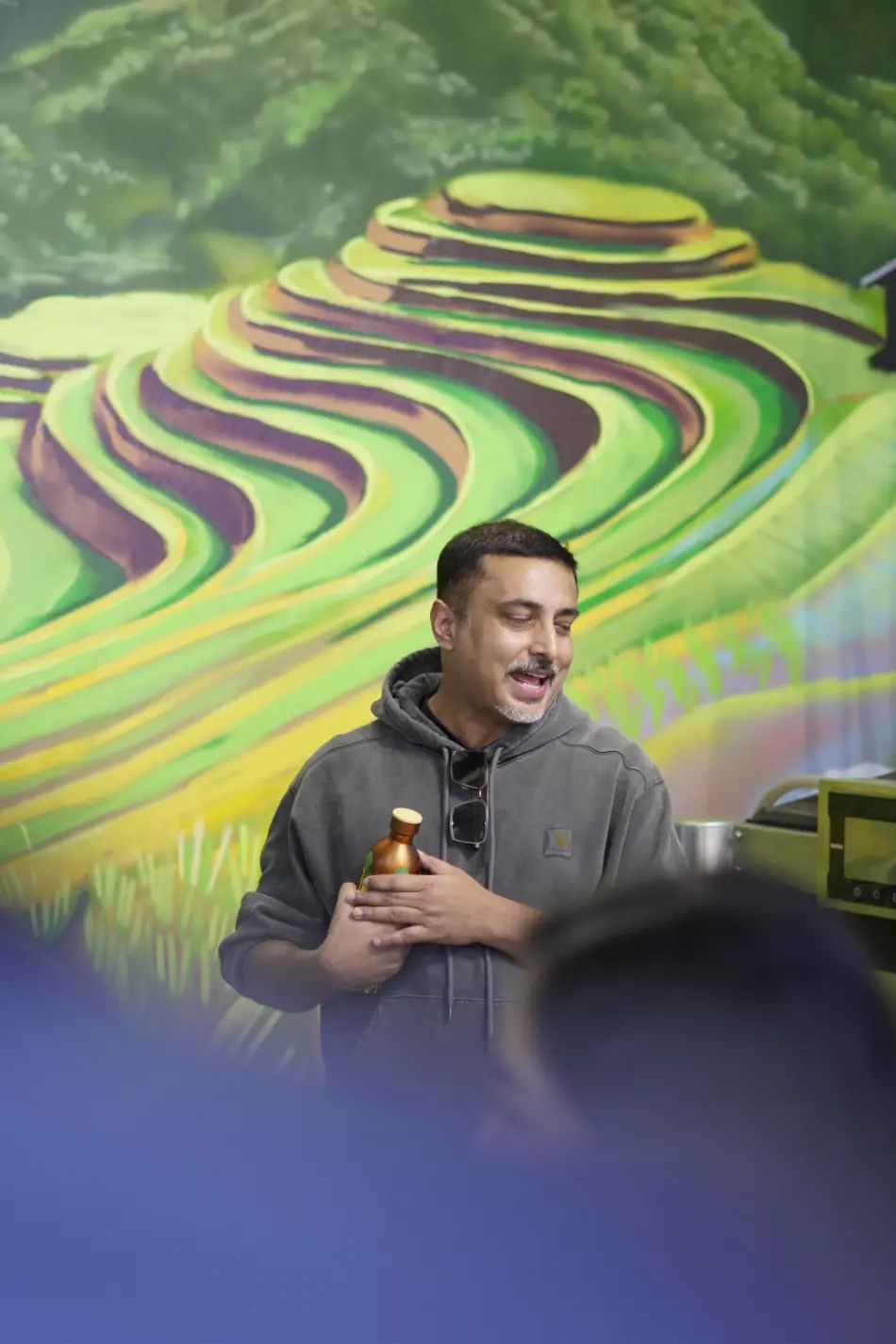 Mayukh in front of the still, as he presents the new expression
He explains the gin-making process in detail. “Think about a pressure cooker,” says Mayukh, “Throw in the ingredients, the water goes up, it cools down in this chiller (which takes the spirit down to 7C). Vapours rise, cool, reach the copper plates (inside the steel tubes leading to the pot still, drop inside, creating the gin.”
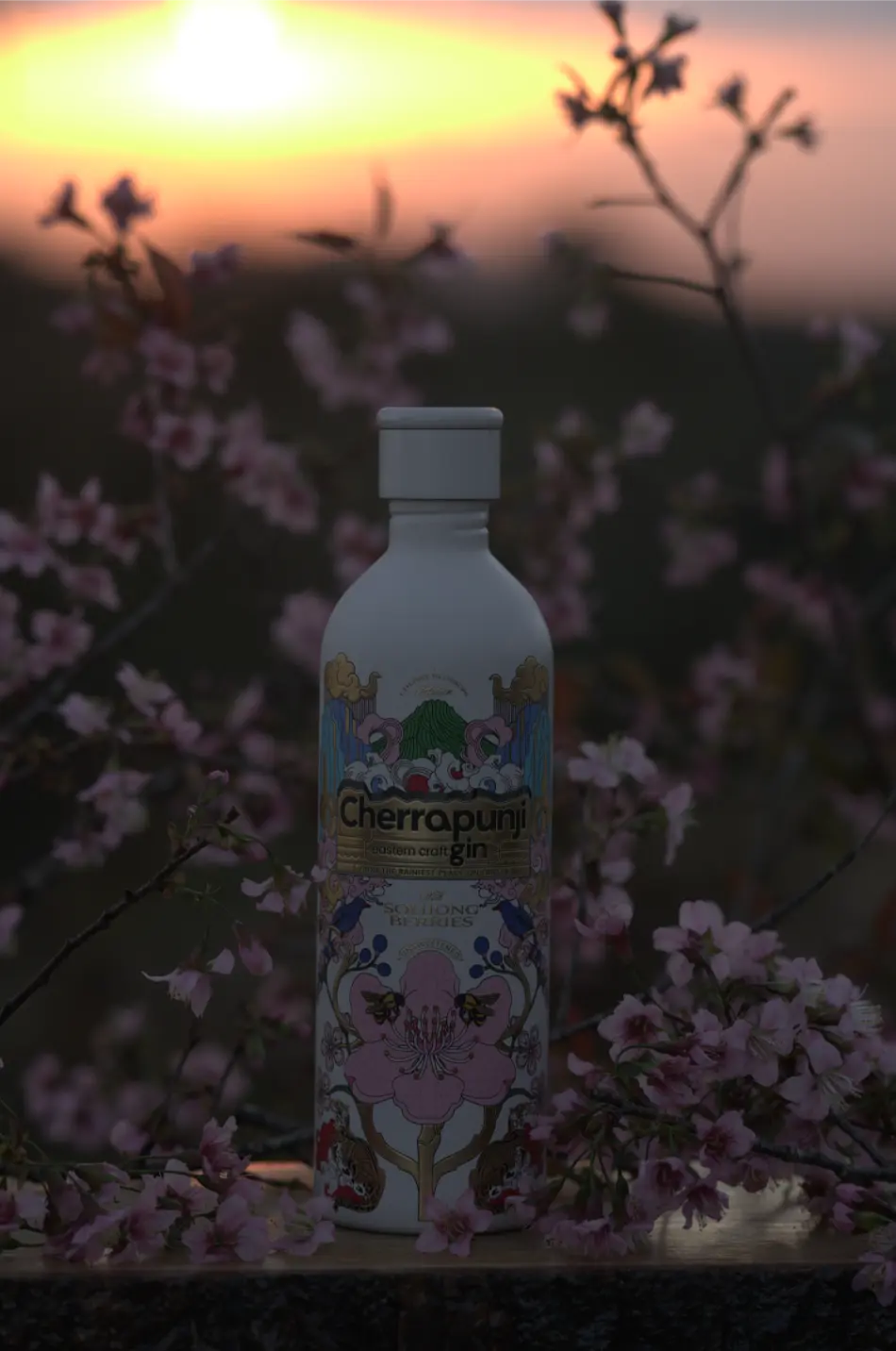 The new Mountain Berry Cherry Blossom surrounded by cherry blossoms
“I’m asked why I use rainwater,” says Mayukh, as he points to the special white rainwater harvesting tank that sits just off the distillery courtyard. “It’s very special to us, in this area known for rain. If there is anything people can take back from the rainiest place on earth – it’s gin with the flavours of the place thanks to our botanicals. All of it in a reusable, stainless-steel bottle.”
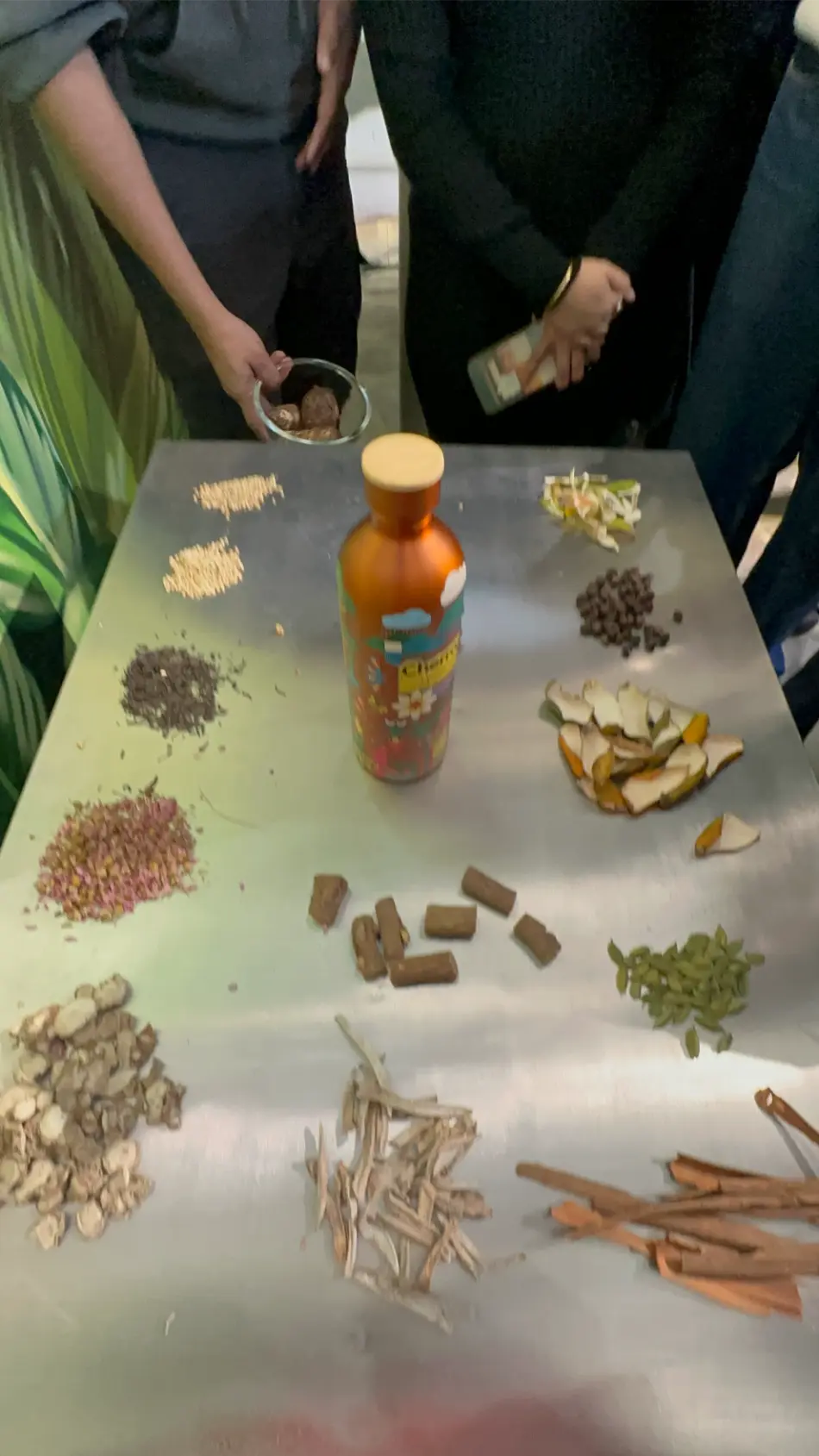 The botanicals that go into the Cherrapunji Gin
The magic is in the botanicals
What are the 12 secret botanicals found in the Cherrapunji Eastern Craft Gin? “I put botanicals from all around the northeast of India, not just Meghalaya,” says Mayukh, as he points to a table laded with small bunches of all the dried botanicals that to into the spirit: peppercorn; tea smoked with pine needles; cherry blossom petals mixed with chamomile; liquorice; angelica root (acts as a binder); dehydrated taro root; smoked cardamom from Sikkim; juniper from Sikkim and Arunachal Pradesh; GI-tagged Khasi lemon; Khasi mandarin (known for its sweetness and fragrance); kuttu atta (roasted buckwheat); parrot coriander seeds from Assam.
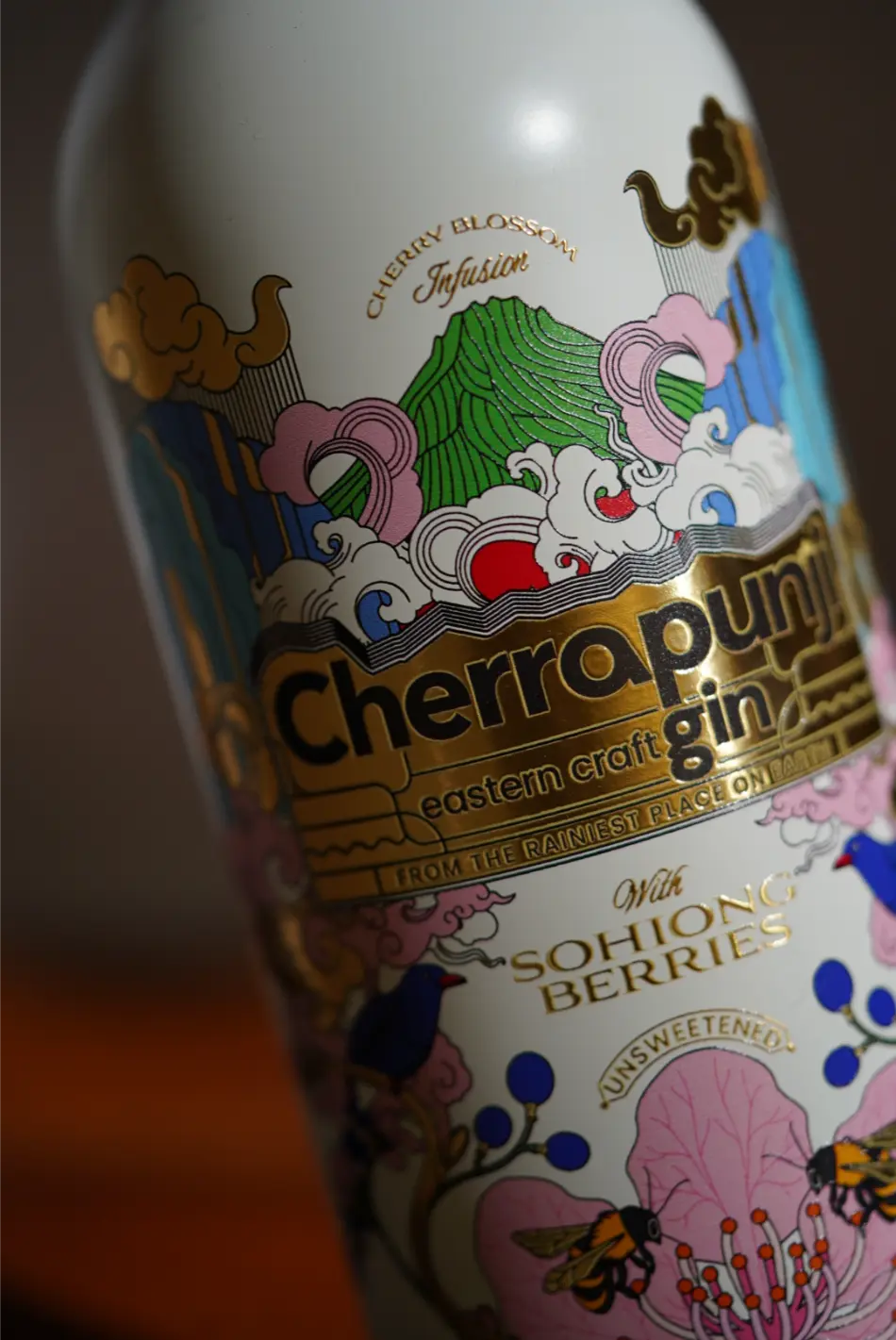 The gold embossed white bottle with the attractive graphics
A gin that’s pink, but made from a rare berry
Cherrapunji Eastern Craft Gin’s latest expression, the Mountain Berry Gin with Cherry Blossom, launched on that sunny day in December at the distillery, comes in a white stainless steel bottle (again designed by Reshidev RK), with gold-embossed graphics of the pink cherry blossom with bees hovering around it, purple Sohiong berries, leopards, the Cherrapunji hills, and of course, the precious rain clouds that give its rainwater used in the spirit.
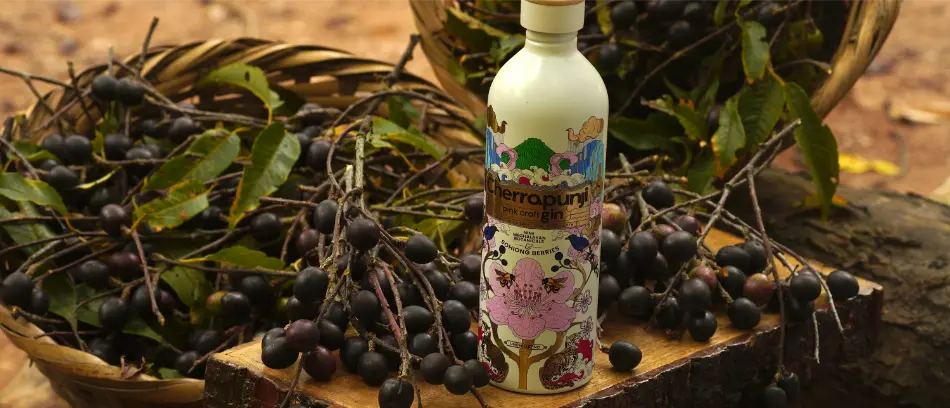 Sohiong berries are macerated with the gin
“This is the Sohiong berry,” says Mayukh, “It literally means ‘black fruit’ in Khasi. It only blooms for six weeks, and we store it in -30C after farmers pick it in the wild.” This berry is key for making the unsweetened, pink gin. There’s no added sugar, flavour, or colour. He tells us that this year, he’s bought nine tonnes from farmers. But next year, he’s changing the game.
“I have given a minimum guaranteed order of 30 tonnes to the farmers, and they are already at work, so we have decided to farm the Sohiong berry for the first time,” says Mayukh.
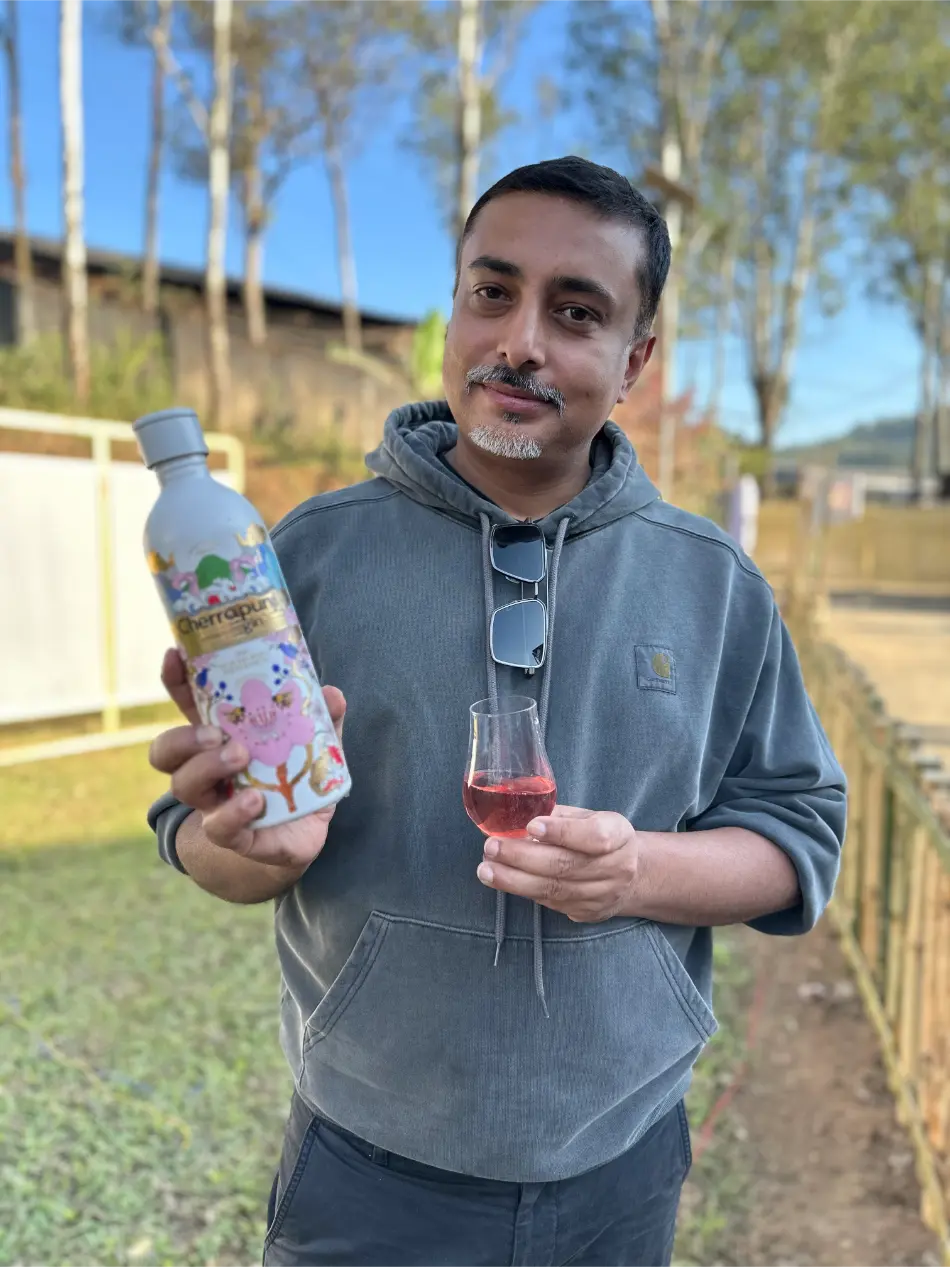 Mayukh Hazarika with the new Sohiong Berry expression
Another surprise awaits in the new expression with the Sohiong berries. The white stainless-steel bottle cap has an in-built jigger, for the perfect pour at 30 ml, a design that has been patented/patent applied in India, China, and the US. “Nobody else thought about creating this,” says Mayukh, “We are bringing this cap design to our mother variant and in our one-litre bottle for export as well.”
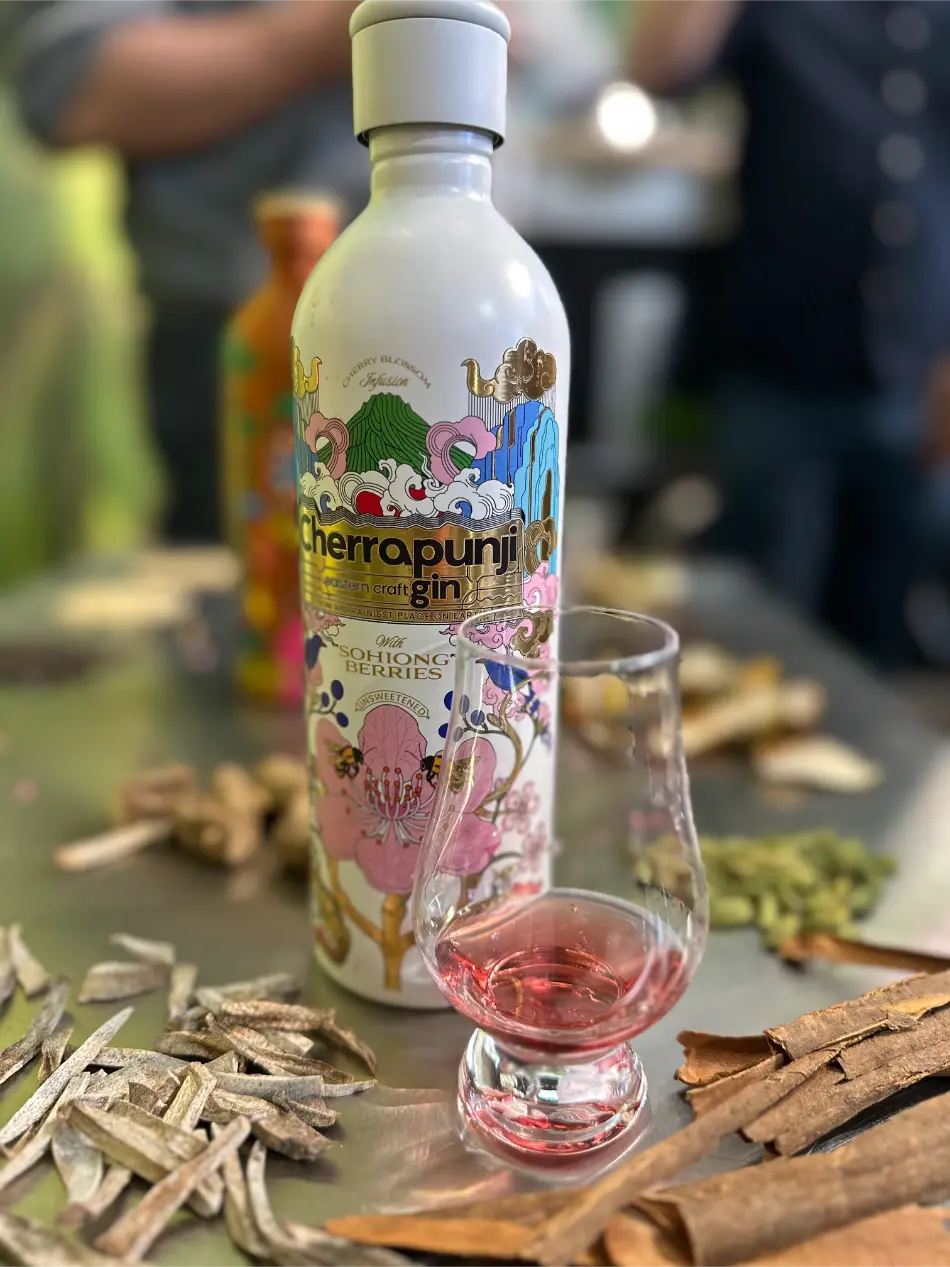 The pink Mountain Berry Gin with Cherry Blossom
“I’m very pleased with the way it’s come out,” says Mayukh. “It’s India’s first real berry gin – not just pink, which is shallow, but a genuine berry-flavoured gin.” He says that they have to prepare the base gin first, and in the base gin, they add the berry, the dried chamomile and cherry blossom, and let it all macerate. They let this sit for almost six weeks. Then the base gin is mixed with the berry concentrate – to create the Mountain Berry Gin with Cherry Blossom.
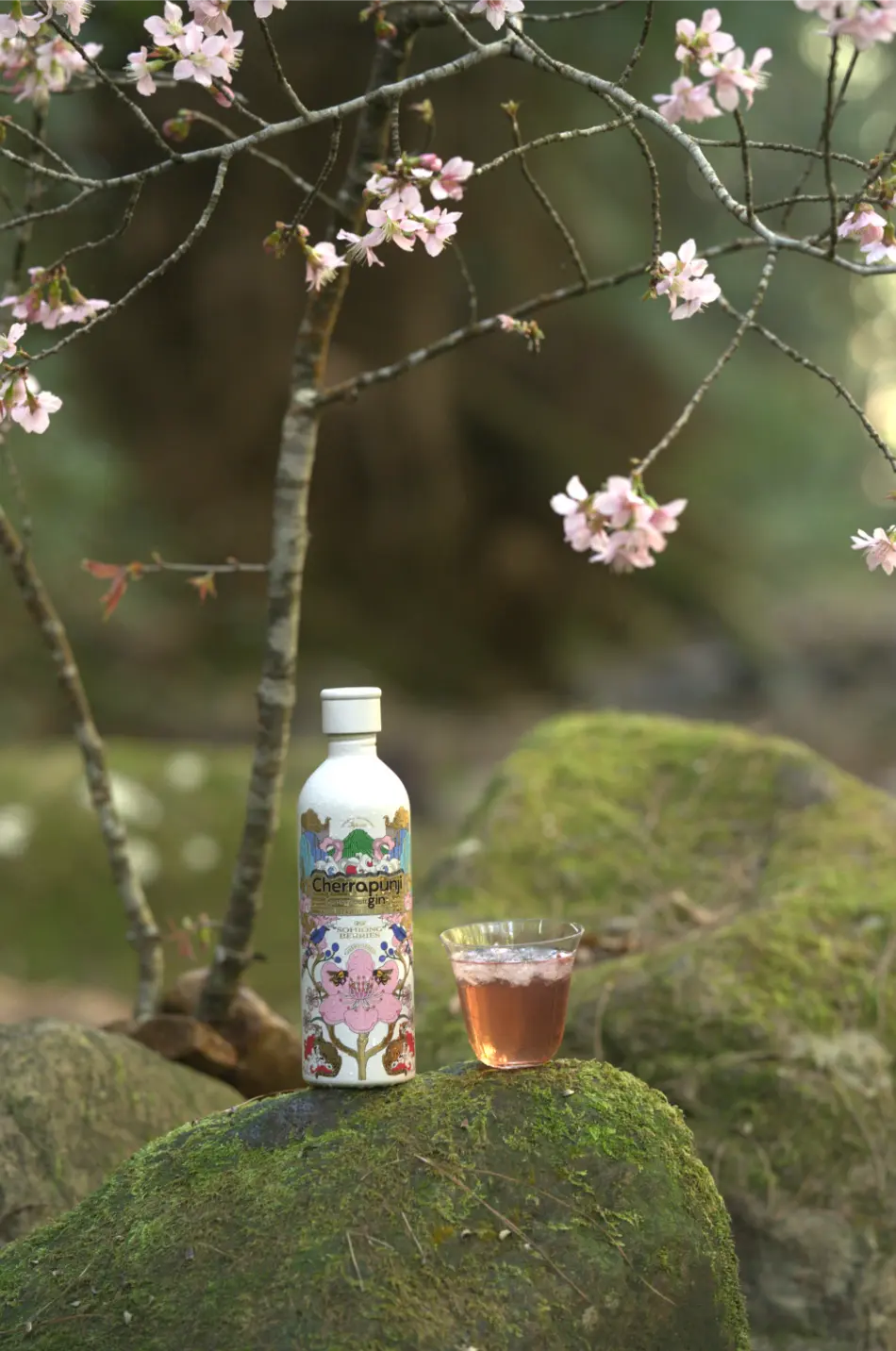 The berry expression is tart on the nose
On the nose, it’s very sweet and floral with a whiff of citrus; on the palate, the taste is fruity-tart, with a hint of sweetness and silkiness, and a lingering berry finish, best brought about by adding a splash of water. The colour is a beautiful berry pink in the glass.
Presently, Mayukh says he’s limited to making 100,000 cases of Cherrapunji Craft Gin a year, that is 12 lakh bottles a year. The Mountain Berry Gin with Cherry Blossom expression will be limited to 60,000 bottles – a small batch, while he awaits the berries’ next season, which starts in September, for six weeks.
 The table is laid
An open-air Khasi feast with the Mountain Berry Gin with Cherry Blossom gin
Paired with our glasses of ice cold Mountain Berry Gin with Cherry Blossom gin with tonic and soda – another Gin Sonic – we are introduced to a modern rendition of a typical Khasi meal, under the bright Meghalaya sky.
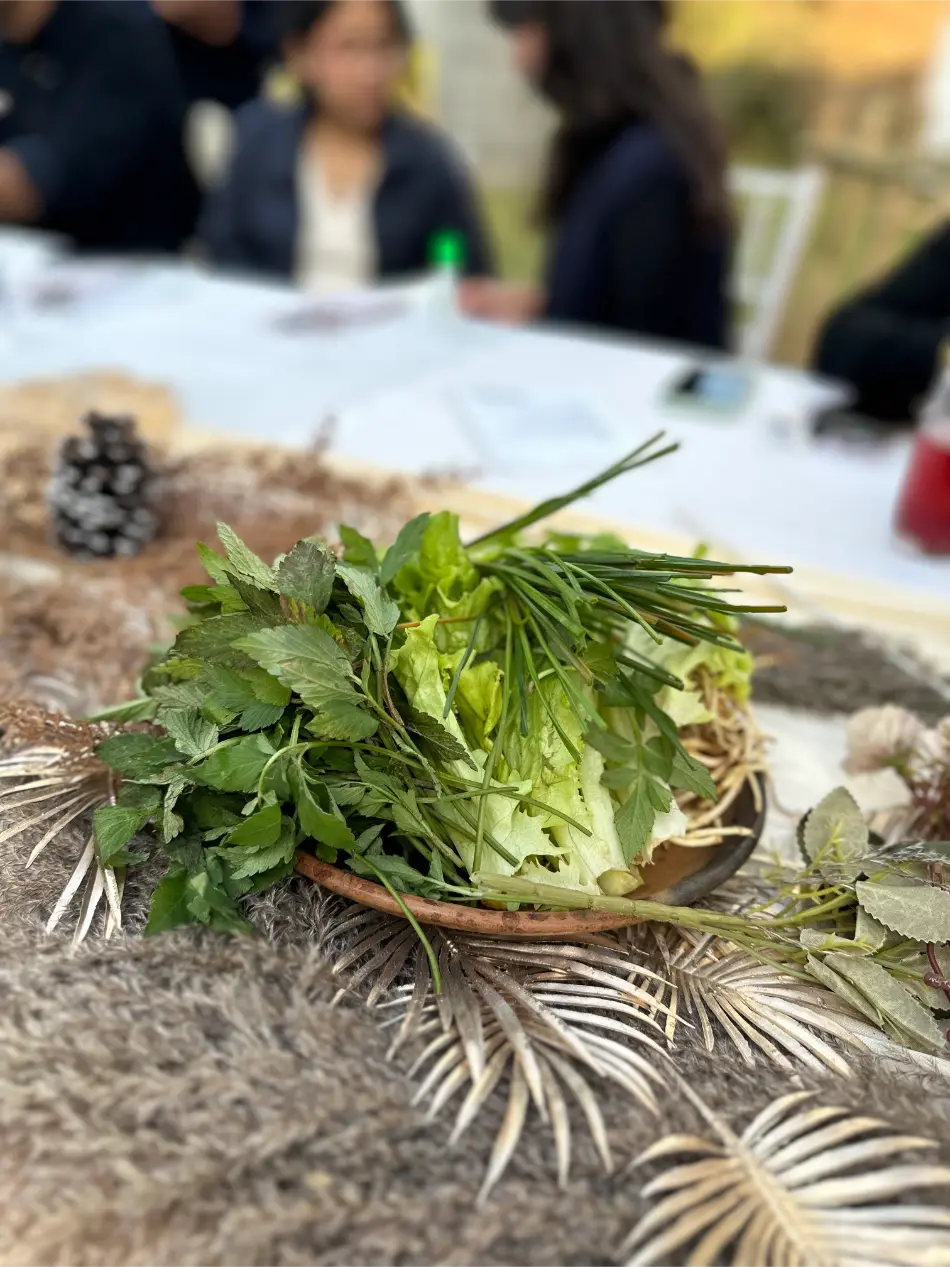 A Khasi salad
A salad of Jyllang (green garlic), Perilla salad and locally grown leaves and herbs, surrounded by dips such as an Orange dip (tree tomato chutney, which is tangy), a dried fish chutney with tomatoes (a Khasi staple) appears at the centre of the table. Then we are served a Syrwa Syiar (a hearty chicken broth made with local pepper and herbs) or for the vegetarians, a Syrwa Soh Phlang (an earthy broth made with local tubers and coriander); Phan Karo (sweet potato chaat Khasi style) or Putharo bad Doh Syiar Khish (rice pancakes with shredded chicken and perilla); Ja Stem (rice cooked with Lakadong turmeric); Doh Sniang Thad Shet Sboh (smoked pork curry); Doh Syiar Mylliem (chicken cooked Mylliem style with onions and black pepper); Dal Nei Iong (lentils cooked with black sesame); Jhur Sdieh (Khasi home style fried vegetables); Jyntah Shriew (hearty yam stew with tomatoes and local herbs); Rymbal Ja Nei ileh (rice beans cooked down with perilla paste); and a dessert of corn milk pudding with charred corn, and Sohiong Compote.
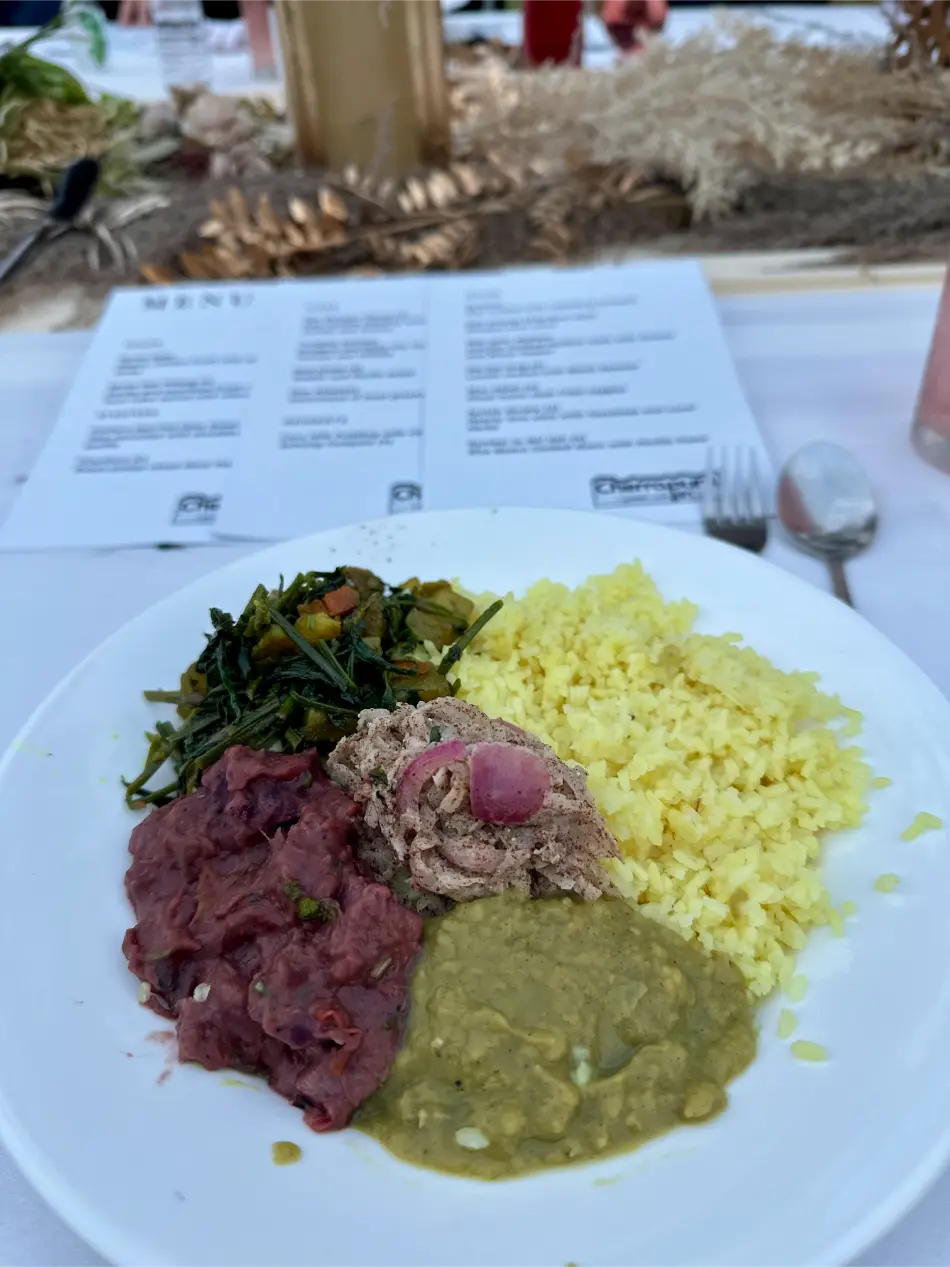 A hearty Khasi meal
Our last act before the musical evening ahead is getting the chance to prepare our very own Christmas gin for the ginmaker – with Mayukh and Master Distiller Aanchal supervising the process – as one of us takes the Christmassy botanicals of star anise, raisins, cloves, vanilla, cinnamon, bay leaf, and nutmeg and pour them into the smaller pot still.
Local talent, and a Spotify fave, DJ Finding Mero’s melodic house tunes then blur the lines between reality and dream with a stunning visual projection on the distillery’s front wall, to commemorate the launch of the Mountain Berry Gin with Cherry Blossom.
 Priya Rana with Mayukh Hazarika at Shad Skye
A final celebration in Shillong
Shillong comes alive at night, and the place to be is Shad Skye, a rooftop cocktail bar in the heart of town. Head mixologist Rishot Laloo shows me tonight’s special menu: Rice wine (welcome drink), Soh-iong Highball, Soh-iong Martini, Living Roots, and Gin highball.
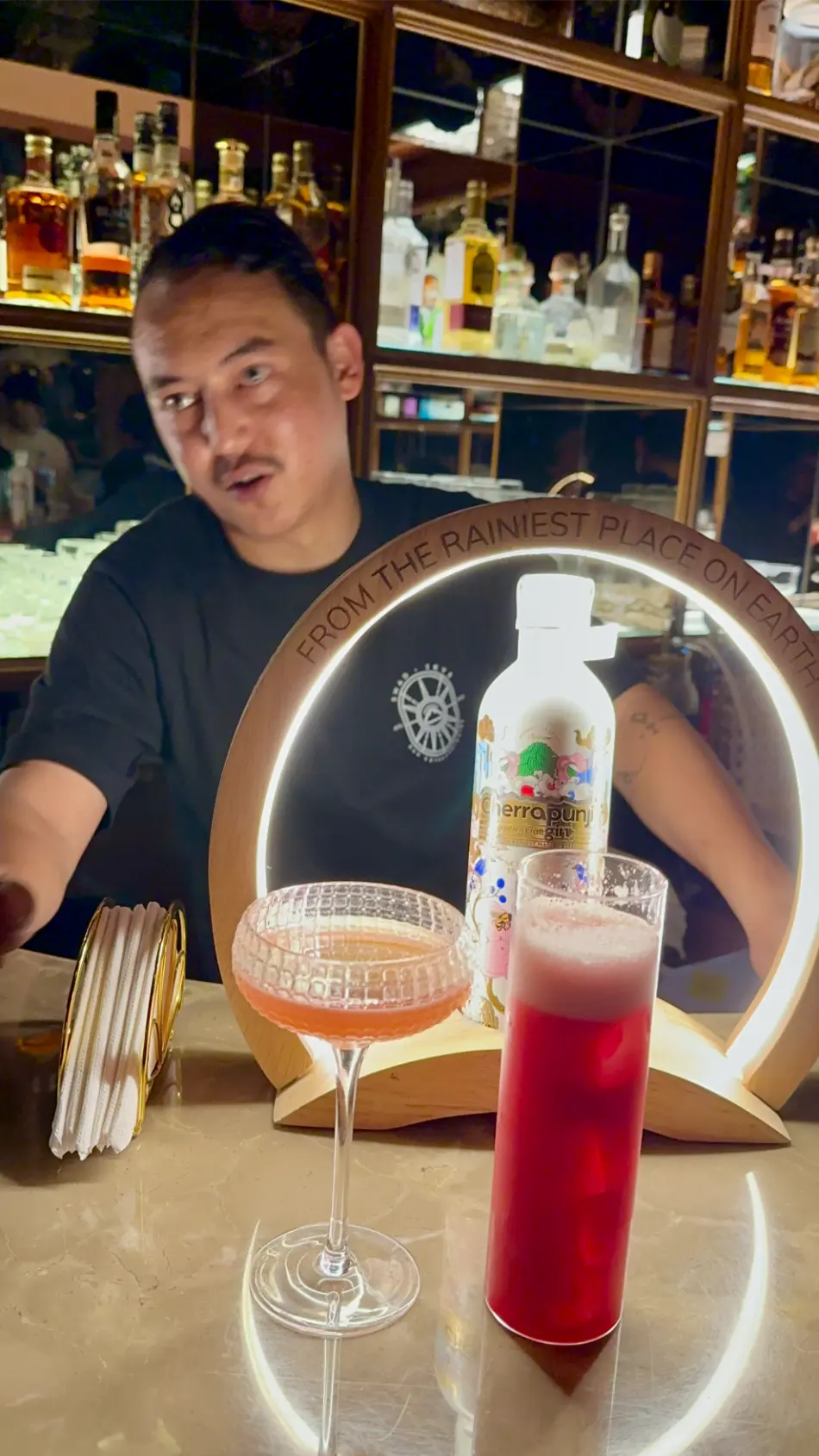 Cocktails using local lore and ingredients, by head mixologist Rishot Laloo
Living Roots evokes the aromas of a verdant Meghalayan forest, teeming with flora, with sweet carrots, Khus root, smoky pinewood, silky white chocolate, and the mother expression of Cherrapunji gin. I also get to try out Tuaite, a bamboo-inspired cocktail with vodka, jasmine syrup, ginger, and of course bamboo shoots. The last of the trio I sip is the shocking pink Terpenes, a tequila based drink that evokes the earthy aroma of a first rainfall in Meghalaya (caused by releasing a plant oil known as a terpene), made with beetroot hydrosol, and stone flower to give a whiff of the forest.
The sweet memory of Meghalaya remains long after I leave, captured in an endearing bottle of Mountain Berry Gin with Cherry Blossom.
The Mountain Berry Gin with Cherry Blossom is currently available in Meghalaya for ₹3,300 and in Goa for ₹3,200.
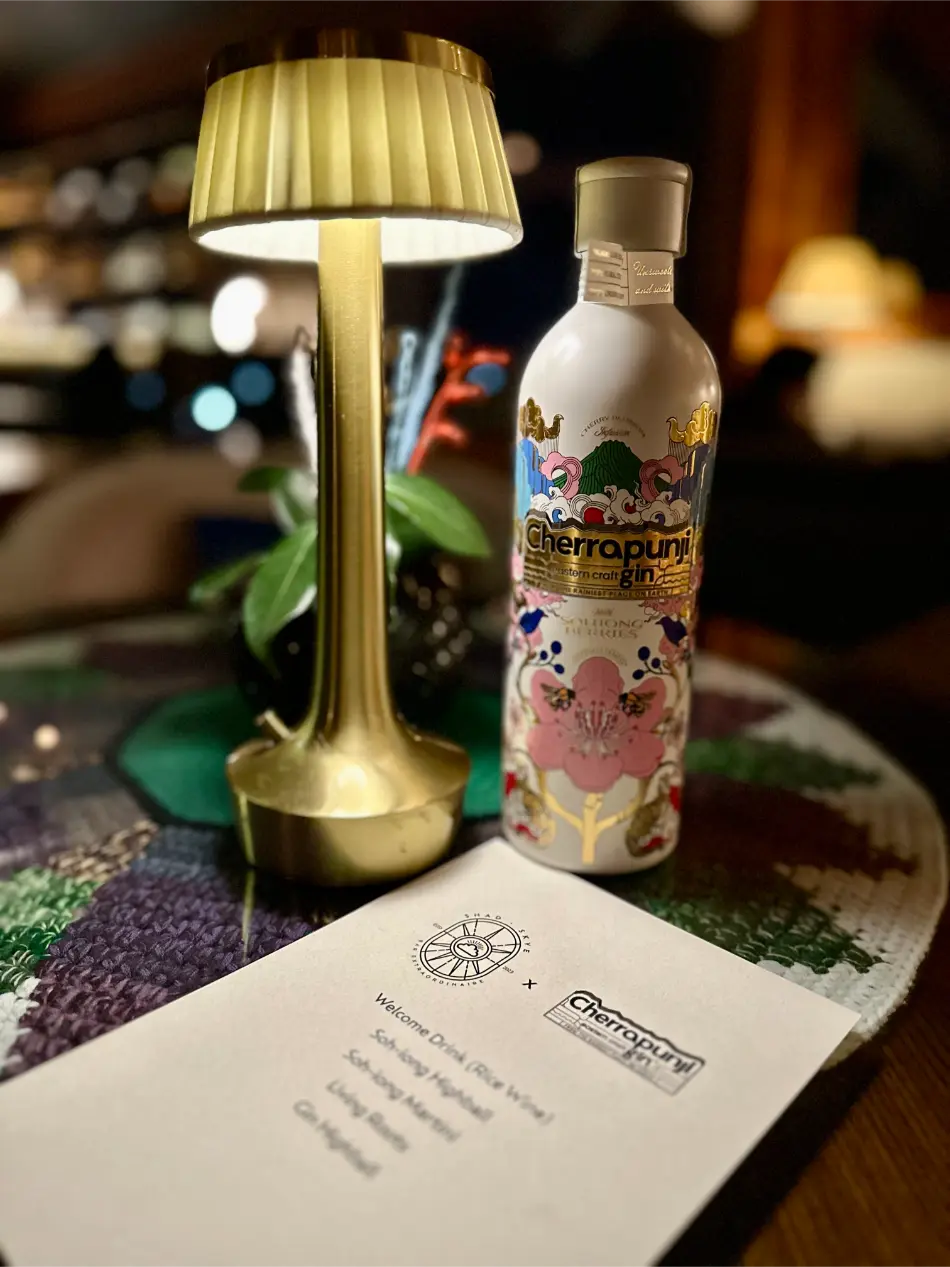 This rooftop bar in Shillong serves Cherrapunji Gin's latest expression, in delicious cocktails
FOLLOW US ON INSTAGRAM
© Copyright 2026, all rights reserved with Lifestyle Insider
Designed & Developed By : 

Lifestyle Insider is a kind of junction point, connecting people with diverse interests that touch on the more luxurious aspects of lifestyle – fashion, design, travel, food and spirits, art, watches and jewellery, cars, yachts, and aviation, and technology. People today don’t fit into boxes and categories. In our individual ways, we are interested in diverse themes, products, and the challenges that face our world today. You will judge how well this effort of mine caters to your passions and proclivities.
Lifestyle Insider is a showcase of all that is beautiful and luxe. Behind every creation, is a designer, chef, entrepreneur, or a design maison. I have delved into my own appreciation for objetsde luxe that I have admired over the years – be it a love of fashion from the world’s top Parisian and Italian fashion maisons and their ’90s muses, or the care that goes into sari and Indian textile collections in my own family. Growing up on four continents, as the daughter of a former Indian Ambassador, I’ve seen a remarkable array of historic places and met a myriad people. My aim is to bring my world view into this website, a curation of what I find particularly stunning, unique, and newsworthy.
It’s an exciting time for brands all over the world. With change comes opportunity. With the global ‘reset’ and uncertainty on many fronts, there is a chance to write a new script. Let’s be those pioneers.
A bit about me:
A luxury and fashion journalist with 25 years of experience in publishing and magazine journalism, I have edited some of India’s top fashion and luxury magazines. I got my BA in Comparative Literature from UC Berkeley, and went on to receive my Master’s in English and French from the University of Strasbourg, France. I have also studied German and Film. I live in Gurugram, India, and look forward to once again exploring our world with a new-found freedom.
Priya Kumari Rana
Founder and EditorContact Us
Mail us @ lifestyleinsiderindia@gmail.com